If you run a team in financial services, you already know that a regulator or an employer rarely cares how hard someone studied. They care about the result. The same is true for the vendor certifications that many analysts, operations staff and advisers now sit alongside their day jobs: cloud fundamentals, security basics, data and AI credentials. The exam either records a pass or it does not, and a failed attempt costs time, a fee and some confidence.
That is why one small tool deserves a closer look. Be Ready Education, an independent publisher of practice tests for vendor certifications, offers a free calculator that turns a pass mark into a question count. It does not teach anything and it does not predict your future. It does one narrow job: it converts a percentage into a number you can aim at, and it tells you whether your recent practice scores justify booking the real exam.
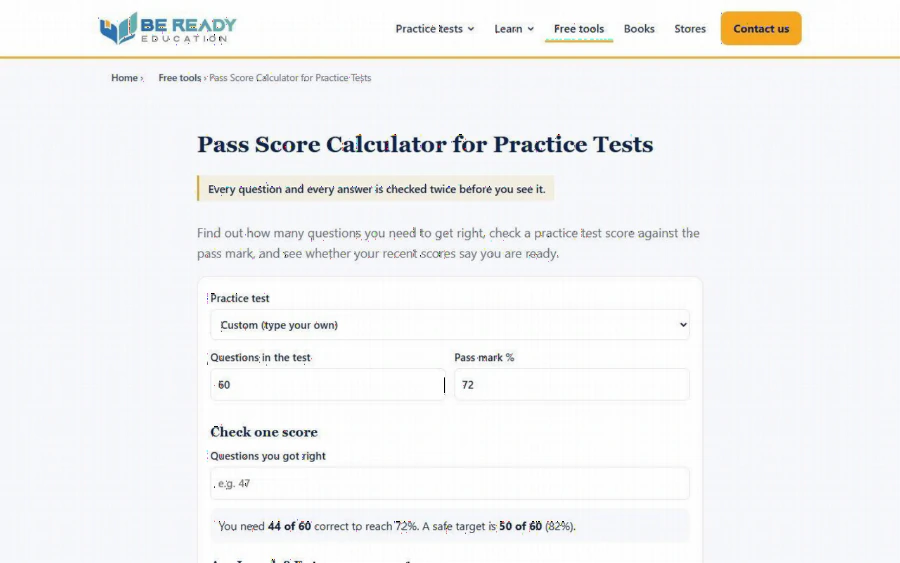
The Pass Score Calculator page with fields for practice test, questions in the test and pass mark percentage, showing a result of 44 of 60 correct
What the calculator does, in plain terms
According to the tool page, there are three parts. First, you choose one of the site's practice tests from a dropdown, or pick "Custom (type your own)" and enter a question count and a pass mark. Second, you type how many questions you got right and see your percentage and the gap to the pass mark. Third, under the heading "Am I ready?", you enter your recent practice scores, newest last, and the page applies a readiness rule.
The arithmetic is simple and the page spells it out. The number of questions multiplied by the pass mark, rounded up, gives the number you need. The page's own example is 60 questions at a 72% pass mark: 43.2, which rounds up to 44. In the screenshot above, the default Custom values of 60 and 72 produce exactly that: "You need 44 of 60 correct to reach 72%. A safe target is 50 of 60 (82%)."
The readiness rule is the more interesting part. According to the page, your scores should reach the pass mark plus 10 points, capped at 95%, on two tests in a row. A 72% pass mark therefore gives a target of 82%, and a 90% pass mark gives a target of 95% rather than 100%. The page describes this as a rule of thumb, not a guarantee, and that is the right way to read it.
A scenario for a team lead (illustration only)
Here is a made-up example, not a real customer story. Imagine a team lead at a mid-sized lending business who has five analysts preparing for the same fundamentals exam over eight weeks. She wants one simple question answered for each person every Friday: should this person book the exam, or keep practicing?
Without a rule, that conversation drifts. One analyst scored 74% once and feels fine. Another scored 70%, 78% and 76% and feels nervous. A one-off score above the pass mark can be luck on an easy set of questions. Two in a row at the pass mark plus 10 points is harder to fluke.
So each Friday she asks each analyst to enter their last scores into the calculator and read the result. A person who clears the rule gets a green light to book. A person who does not gets a specific gap, expressed in questions: "You need about six more correct on a 60 question test." That is a better coaching sentence than "study more."
The point of the illustration is the habit, not the numbers. A shared rule turns a feeling into a decision that two people can look at together.
Why a safety margin is not paranoia
People in finance tend to understand margins of safety instinctively. You do not plan a budget to land exactly on zero. Practice tests are the same. A practice score exactly at the pass mark is a coin flip on the day, because real exam wording, nerves and fatigue all pull in the wrong direction.
The page itself makes an important disclaimer: pass marks, question counts and time limits shown on the site come from its own practice tests, not the real exams, and real exams may differ. The sensible workflow is to read the certification provider's official exam page first, note the actual pass mark and number of questions, and then use the Custom option to enter those real figures. That way the tool works from the real rules, not from a practice test's defaults.
Where it falls short
The tool has limits, and a good review should say so plainly.
- It measures only what you type in. If your practice tests are too easy, a high score will give false comfort. The calculator cannot see the quality of your questions.
- The readiness rule is generic. It does not weigh topics, so someone who is weak on one domain but strong elsewhere can still clear it.
- It does not teach. The page points to "review the explanations for every question you missed," which means the learning happens in the practice test, not in the calculator.
- The pass mark for many real exams is reported on a scaled score, not a simple percentage, so converting it to a question count is an approximation. Check how your exam vendor reports scoring.
On the positive side, the page says everything runs in your browser and that nothing you enter is collected, stored or sent, with no cookies set. For people who do not want to create an account just to check a score, that matters.
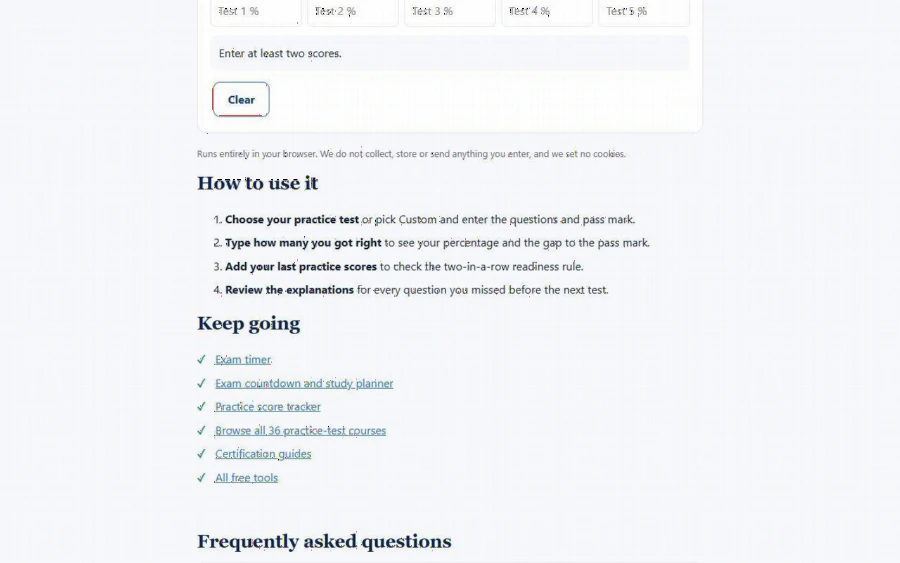
A lower section of the calculator page with fields for five practice test percentages, the how to use steps and links to related tools
Who should use it and who can skip it
This tool suits a few groups well. Busy professionals who study in short evening sessions and want a quick yes or no on readiness will get value from it. Team leads and training coordinators who support several people at once can use it as a common yardstick. Career changers preparing for a first vendor credential can use it to stop second guessing themselves.
It is less useful if you have not yet taken any practice test, because there is nothing to enter. It is also not for someone looking for a full study plan or question bank on its own; it is a companion to those things.
How to get started in about ten minutes
1. Find the official page for your exam and write down the pass mark and the number of questions.
2. Open the calculator, choose Custom and enter those two numbers.
3. Take a full practice test under timed conditions, then enter how many you got right.
4. Repeat for a second test, and enter both percentages under "Am I ready?"
5. If you do not yet clear the rule, read the explanations for every missed question before the next attempt.
Be Ready Education also lists three companion tools on its other free tools page: an exam timer that gives pace per question with alerts at 25%, 50% and 75%, an exam countdown and study planner, and a practice score tracker that charts your progress against the pass mark and needs no account. Together with the calculator they cover the practical side of exam preparation: time, schedule, scores and readiness.
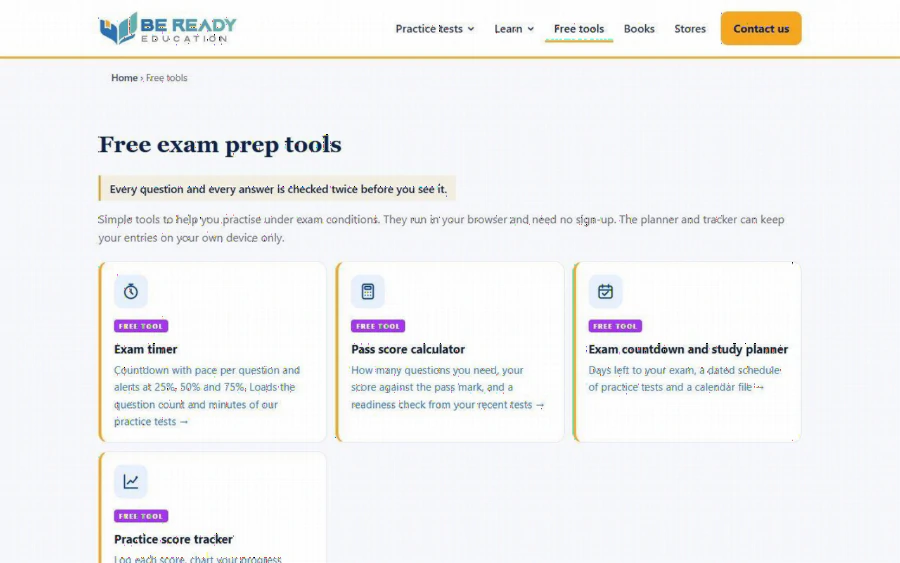
The Free exam prep tools page showing the exam timer, pass score calculator and exam countdown planner cards
The bottom line
A pass score calculator will not make anyone smarter, and it should not be sold as magic. What it offers is clarity: a target number, an honest gap, and a rule for deciding when to book. For a team lead managing several people, or an individual juggling work and study, that clarity is worth a few minutes. Treat the result as one input next to the official exam guide and your own judgment, and keep the margin of safety the page recommends.